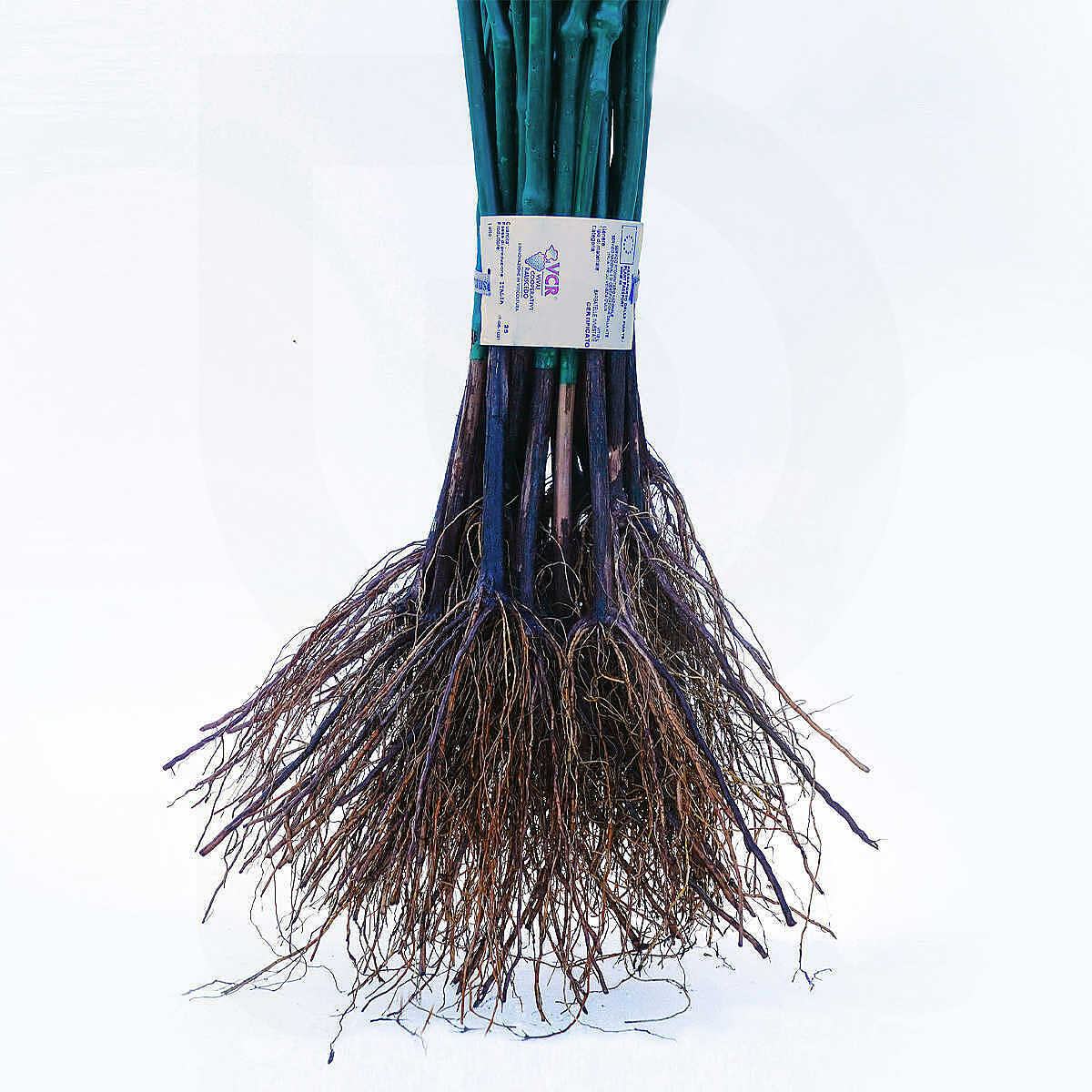
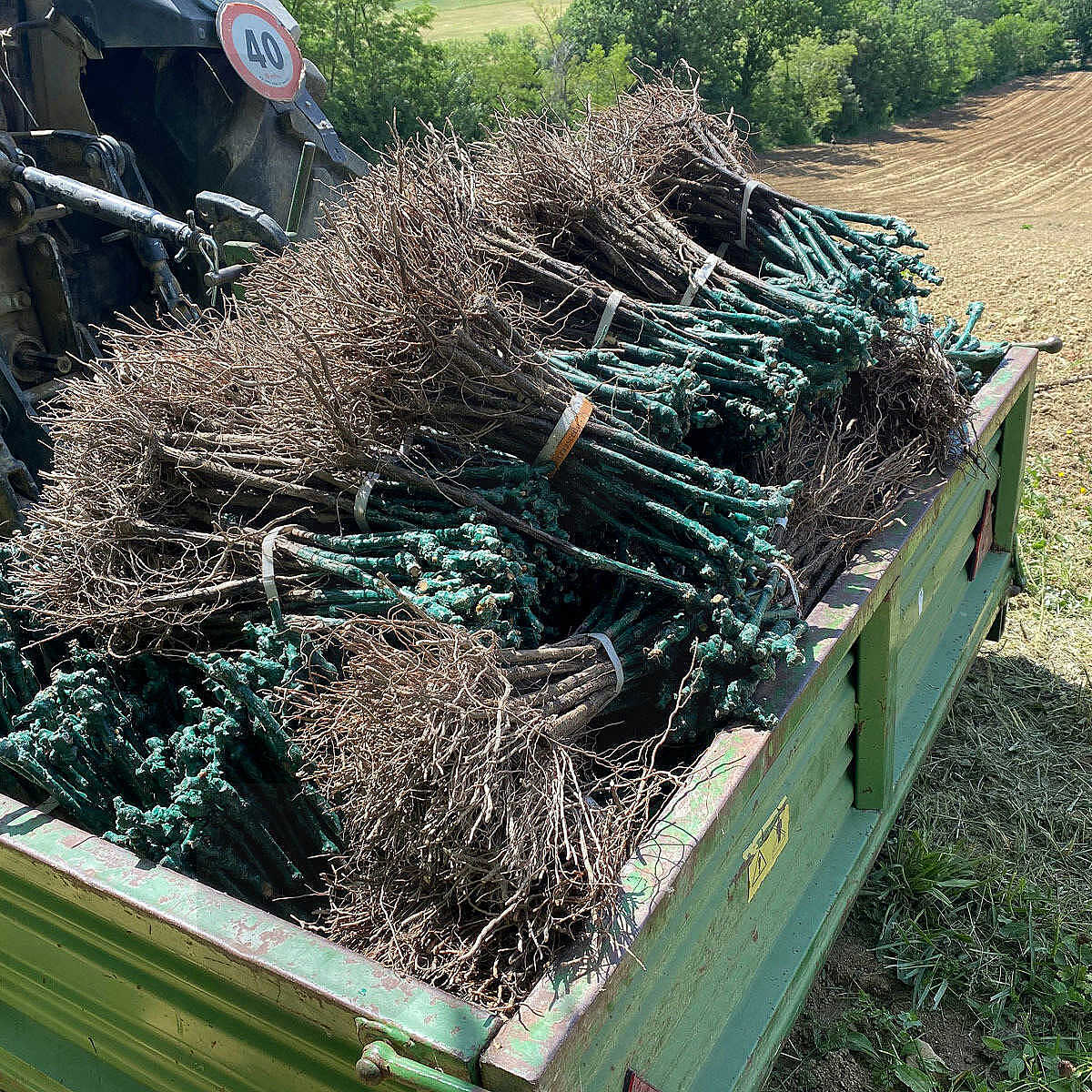
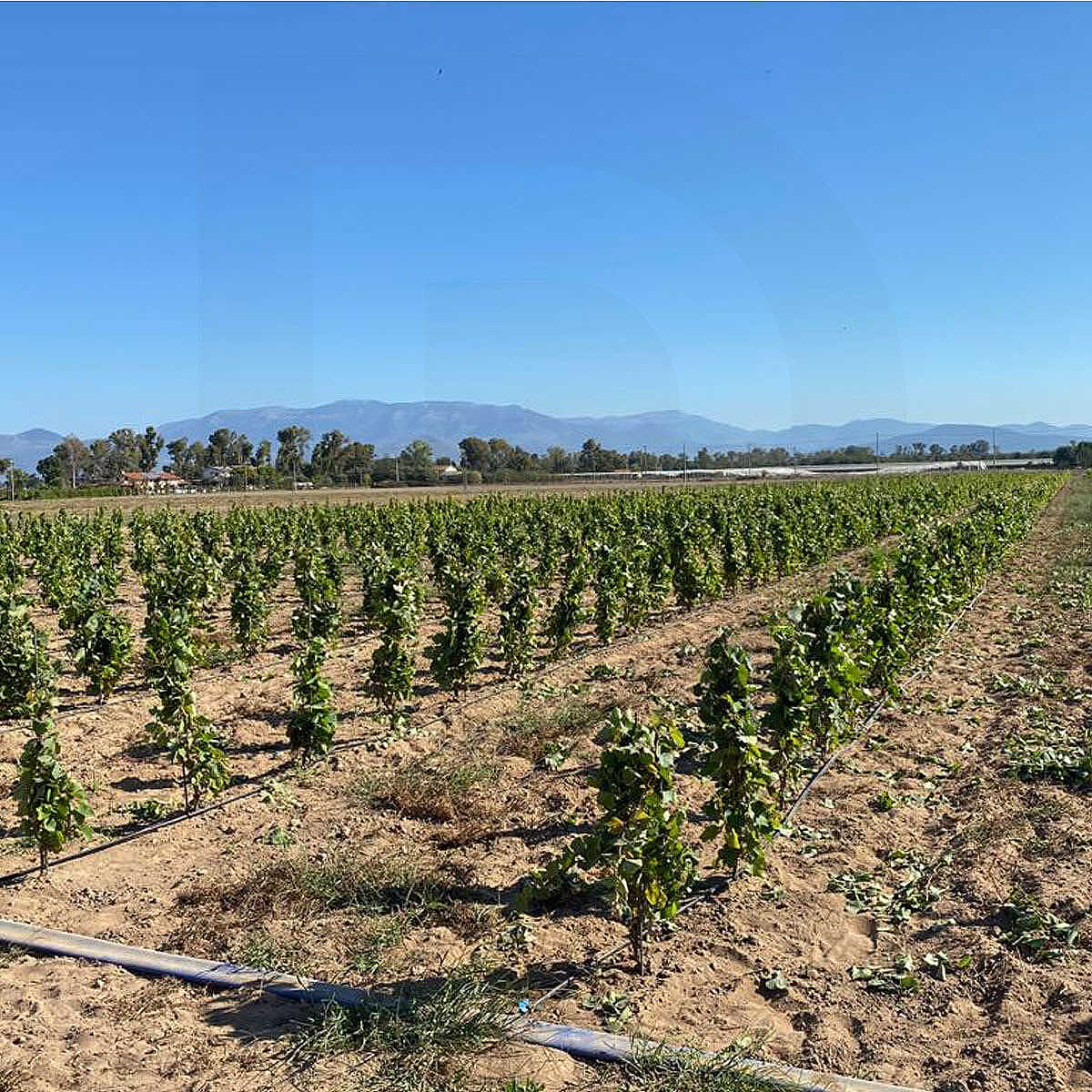
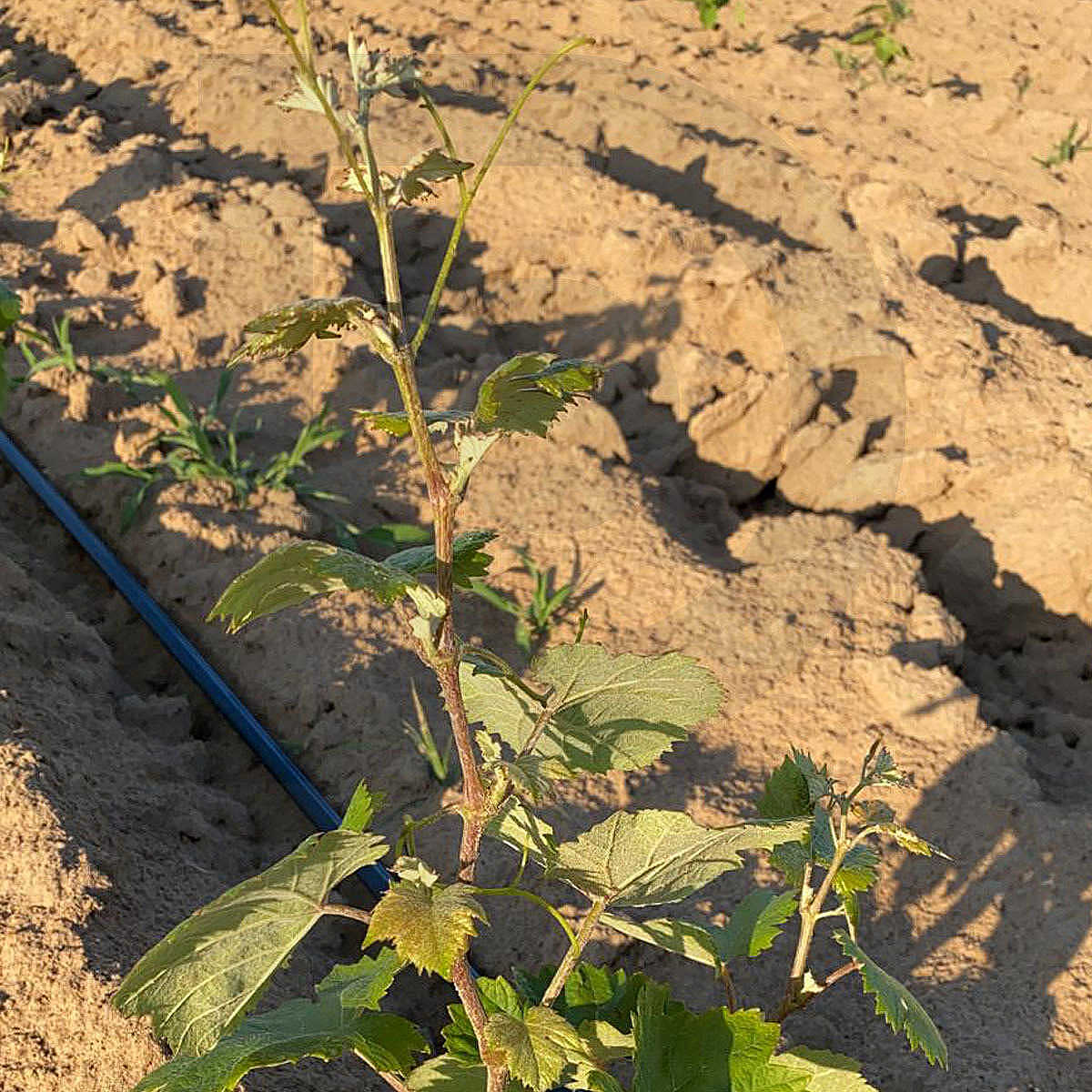
Isabella Nera grafted vines (10 pcs)
Description
 AUTHORIZED RETAILER
Isabella Nera grafted vines (Strawberry Grape) (10 pcs)
Rootstocks: 1103P - K5BB - S04 - 140RU - 420A (We will send you the graft carrier available at the time)
Ampelographic Characteristics:
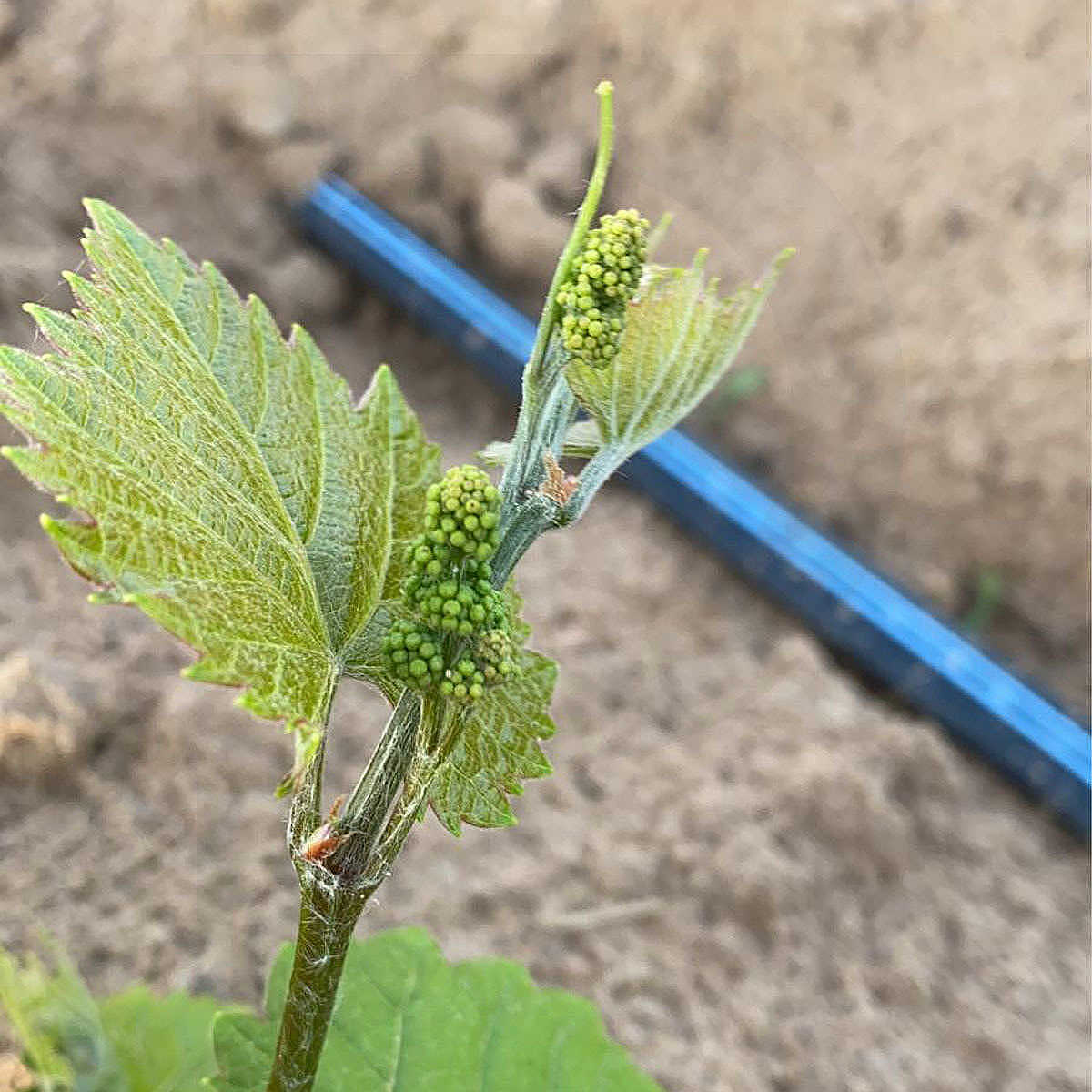
- Shoot: young leaves slightly golden on the upper side and bright pink on the lower side, with veins bearing sparse rust-colored hairs that flatten very early; the young flower clusters emerge immediately, are green with a wine-colored tip, and are early visible beneath the downy hairs of the bud scales that envelop them.
- Herbaceous cane: elongated and narrow, straight, dull-colored, wrinkled, covered with a light bloom near the nodes.
- Tendrils: continuous, strong, green-yellowish or dirty pink, slightly arachnoid, with long, sparse hairs.
- Leaf: large or very large, wider than long, thick, trilobed; lateral sinuses slightly marked; petiole sinus deep, open in a narrow V-shape and sometimes closed by overlapping lobes; blade blistered in the center and smoother along the edges, glabrous on the upper surface which is intense pale green, tomentose on the lower surface and well covered with a white cottony layer; teeth rounded, very broad, sharply pointed, in two clearly distinct series; veins pale green on the upper side, very prominent on the lower side, with woolly hairs.
- Petiole: long and thick, greenish, carmine-colored, with soft, loosely arranged tufts of hair positioned at right angles to the plane of the leaf blade.
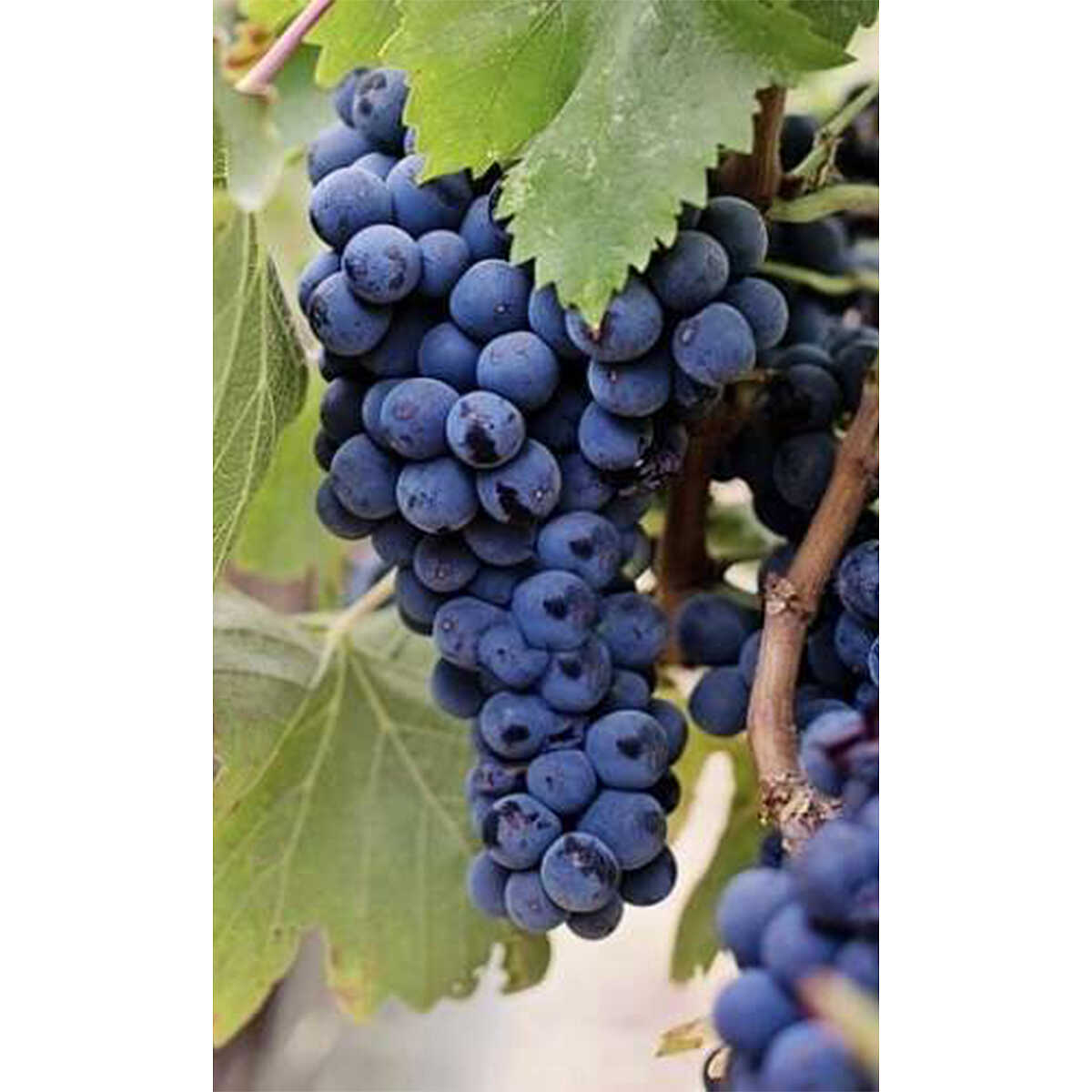
- Cluster at industrial maturity: medium or above average, cylindrical, rounded at the tip, loose with short wings; peduncle short, woody at the attachment point and medium thickness; rachis green; pedicels green, thin, very long, warty, ending in a flattened disc.
- Berry: larger than average, nearly spherical (slightly oval); deep purple, almost black when fully ripe, but more often reddish, with some berries remaining green; covered with abundant bloom; central navel with persistent stigma; skin thick, leathery, tart and acidic; firm pulp with very pronounced foxy aroma; juice slightly red-colored, with wild and foxy flavor; brush long, vinous, weakly attached to the berries.
- Seeds: one to four, large, grouped, short-beaked; chalaza and raphe absent, replaced by a very marked circular depression.
- Woody cane: violet-brown in color, lighter in the median part of the internodes and darker near the nodes; internodes rather long, finely striated with shallow and irregular grooves; nodes flattened.
- Trunk: vigorous, spreading growth habit, powerful; old bark slightly adherent, peeling off in narrow, irregular strips.
Phenology:
- Observation conditions: ampelographic and phenological observations were conducted in the vineyards of the “Rinascita” Farm in Spilimbergo (PN) during the five-year period 1992–1996.
- Altitude: 36 m above sea level.
- Site: flat.
- Training system: Casarsa-Friuli.
- Planting distance: 1.40 × 2.80 m with double stake.
- Soil: gravelly.
Vegetative Stages:
- Bud break: early.
- Flowering: early.
- Veraison: late.
- Grape ripening: late, IV period.
- Leaf fall: early.
Characteristics and Cultivation Aptitude
- Vigor: high.
- Yield: abundant.
- Average number of inflorescences per shoot: 3–4.
- Resistance to pests and other adversities: excellent resistance to downy mildew.
Use
- Exclusively for distillation and as a table grape. This is a productive hybrid producing grapes particularly intense in aroma and flavor, with the characteristic foxy note. The grapes are therefore fermented and distilled for the production of distinctly fragrant and delicate grappas. It has also always been used as a table grape.
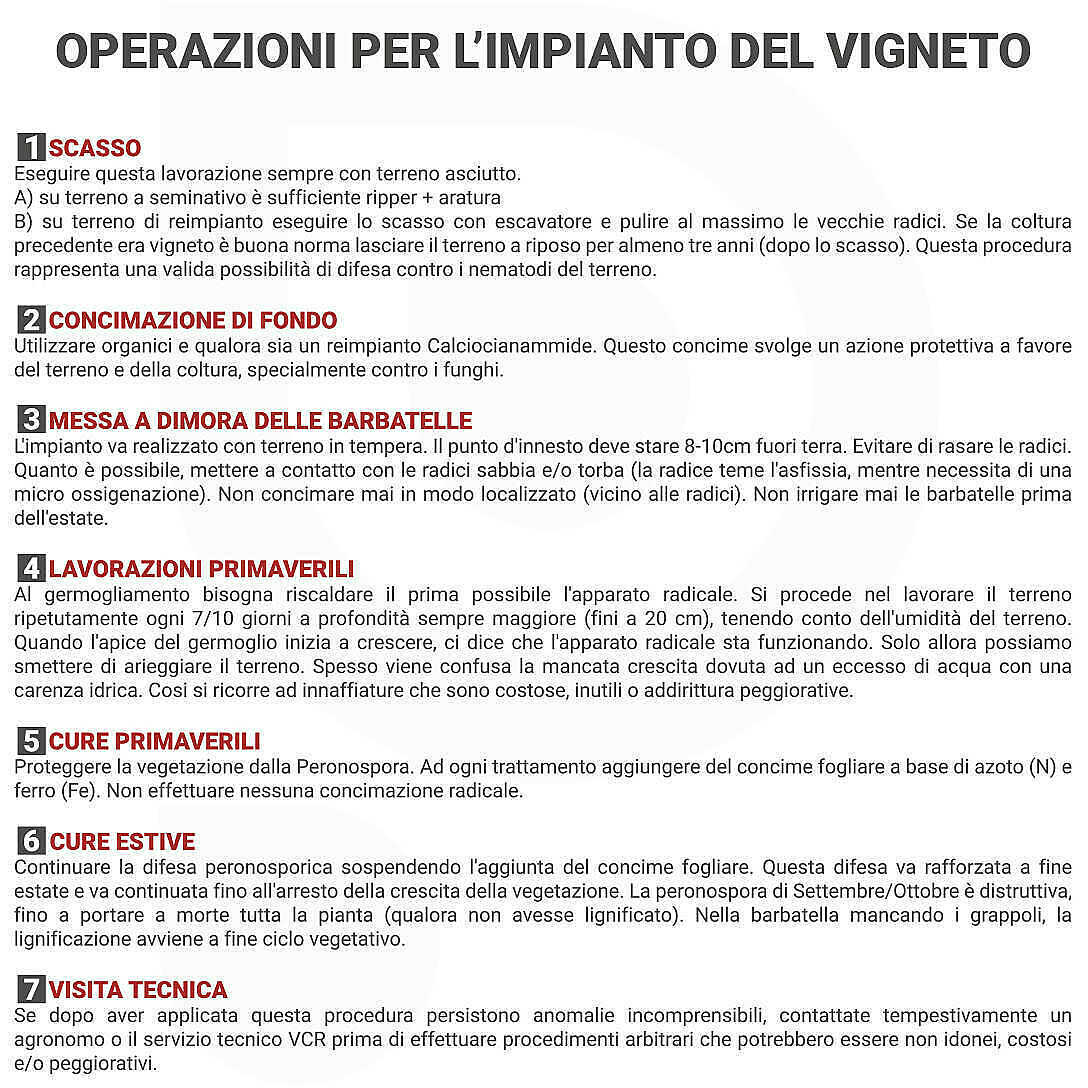
RULES TO PLANT A VINEYARD
1. PLOW
You must perform this operation always with dry soil
A) On arable land is generally sufficient to ripper + to plow
B) On planting soil is generally sufficient to plow with an escavator and to clean the old roots.
If the previous crop was a vineyard, it is a good idea to leave the soil fallow for at least three years (after plowing). This procedure represents a valid possibility of defence against soil nematodes.
2. SOIL FERTILIZATION
Use organics and if it is a reimplantation, use Calciumocyanamide.
This fertiliser has a protective effect on the soil and the crop, especially against fungi.
3.PROPAGATING GRAPE VINE CUTTINGS
The planting should be carried out in temperate soil. The grafting point should be 8-10 cm above ground. Avoid shaving the redices. As much as possible, put sand and/or peat in contact with the roots (the root fears asphyxiation, while it needs a micro-oxygenation). Never fertilize in a localized manner (near the roots). Never water the rooted cuttings before summer.
4.SPRING WORKS
When sprouting, the root apparatus must be heated as soon as possible. Work the soil repeatedly every 7/10 days at increasing depth (up to 20 cm), taking into account the moisture of the soil. When the apex of the bud starts to grow, it means that the root system is functioning. Only then can we stop watering the soil. Failure to grow due to access to water is often confused with a lack of water. This is why watering is used which is expensive, useless or even worse.
5.SPRING CURE
Protect vegetation from Peronospora. To each treatment add nitrogen (N) and iron (Fe) foliar fertilizer. Do not make any radical fertilization.
6.SUMMER CURE
Continue with the defense against Peronospora by suspending the addition of the foliar fertilizer. This defense should be reinforced in late summer and should be continued until vegetation growth stops.
The September/October blight is destructive, to the point of bringing death to the whole plant (if it has not lignified). The rooted vine lacks clusters, so lignification occurs at the end of the vegetative cycle.
7.TECHNICAL VISIT
If incomprehensible anomalies persist after this procedure, contact an agronomist or the VCR Technical Service promptly before carrying out arbitrary procedures which may be unsuitable, expensive and/or worsening.